
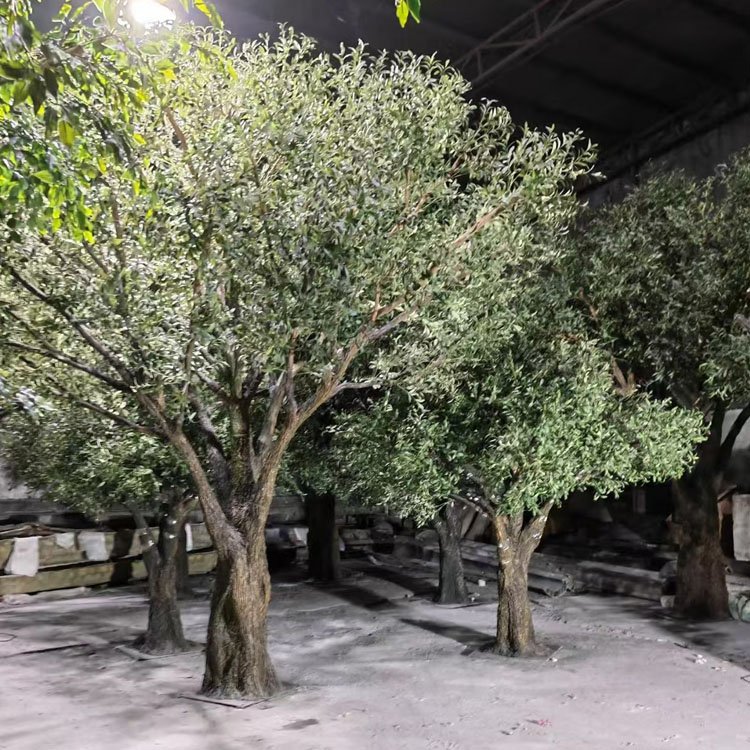
Discover the differences between artificial olive trees and real olive trees. Learn about maintenance, durability, cost, and which option is better for homes, hotels, restaurants, and commercial spaces.
Olive trees have become a popular decorative element in modern interior design, hotels, restaurants, and commercial landscaping due to their elegant shape, silver-green leaves, and strong Mediterranean style.
However, when you want to add an olive tree decoration to your space, many people face an important choice:
Should you choose a real olive tree or an artificial olive tree?
Both options have their own advantages. A real olive tree brings the beauty and vitality of natural growth, while an artificial olive tree provides a long-lasting, stable appearance with almost no maintenance required.
This article will compare the two options from several aspects:
- Appearance and visual effect
- Daily maintenance
- Long-term cost
- Lifespan and durability
- Indoor and outdoor applications
- Installation flexibility
to help you choose the most suitable olive tree decoration solution for your space.
Appearance Comparison: Artificial Olive Tree vs Real Olive Tree
Real Olive Tree
A real olive tree changes continuously with the seasons and its surrounding environment.
It features:
- Naturally irregular branches
- Authentic bark texture
- Natural growth patterns
- Unique plant vitality
A healthy real olive tree is an excellent choice as a focal point for outdoor landscapes, such as:
- Courtyards
- Terraces
- Mediterranean-style gardens
However, the appearance of a real olive tree cannot always remain perfect. Weather changes may cause leaf loss, uneven growth directions, or a less full canopy during certain seasons.
Artificial Olive Tree
A high-quality realistic artificial olive tree can closely reproduce the appearance of a real olive tree through modern manufacturing techniques while maintaining a stable and beautiful look throughout the year.
Artificial olive trees are usually made with:
- High-quality PE leaves (silk-printed leaves)
- Fiberglass reinforced trunks or natural wood trunks
- UV-resistant protective coatings
They offer advantages such as:
- Realistic olive leaf texture
- Natural branch structures
- Adjustable canopy proportions
- Simulated bark effects
For hotels, restaurants, shopping malls, and commercial design projects, artificial olive trees can maintain a consistent, high-end decorative effect for a long time.
Conclusion:
- Looking for natural growth and living plant feeling → Real olive tree has the advantage
- Looking for long-lasting beauty and stable decorative effects → Artificial olive tree is a better choice
Maintenance Cost Comparison
Maintenance of Real Olive Trees
Real plants require continuous care to stay healthy.
Daily maintenance includes:
- Regular watering
- Fertilizing
- Pruning branches and leaves
- Pest and disease control
- Soil maintenance
For outdoor environments, these maintenance tasks may be relatively manageable.
However, for:
- Restaurants
- Hotel lobbies
- Office spaces
- Commercial display areas
maintaining real plants can increase labor costs and management workload.
Maintenance of Artificial Olive Trees
One of the biggest advantages of artificial olive trees is:
Almost zero maintenance while maintaining long-term beauty.
Artificial olive trees are especially suitable for:
- Hotels
- Shopping malls
- Restaurants
- Cafés
- Office buildings
- Event decoration projects
Winner: Artificial Olive Tree
Cost Comparison: Artificial Olive Tree vs Real Olive Tree
Initial Purchase Cost
The price of a real olive tree depends on factors such as:
- Tree age
- Size
- Variety
- Transportation distance
- Planting requirements
Large mature olive trees are usually expensive because they require:
- Difficult excavation
- High transportation costs
- Complex installation processes
The price of an artificial olive tree mainly depends on:
- Height
- Trunk material
- Leaf quality
- Canopy density
- Manufacturing craftsmanship
A premium artificial olive tree may have a higher initial investment than a small real olive tree, but it provides greater long-term value.
Long-Term Usage Cost
Real olive trees require continuous investment, including:
- Water costs
- Gardening maintenance fees
- Fertilizer costs
- Replacement costs
If the plant dies, a new tree must be purchased.
For artificial olive trees, after the initial purchase:
- No ongoing maintenance costs
- Long service life
- Can be reused for different projects
For commercial applications, artificial olive trees are often a more economical choice in the long run.
Winner: Artificial Olive Tree
Lifespan and Durability Comparison
Lifespan of Real Olive Trees
Olive trees are famous for their long lifespan.
Some olive trees can even survive for hundreds of years.
However, their lifespan depends on:
- Climate conditions
- Soil quality
- Water supply
- Professional care and maintenance
If the environment is not suitable, a real olive tree may struggle to grow healthily.
Lifespan of Artificial Olive Trees
High-quality artificial olive trees are specially designed for long-term decorative applications.
Generally:
- Indoor use: Can last 5–10 years or even longer
- Outdoor UV-resistant versions: Can also be used for many years under suitable conditions
They are especially suitable for long-term decoration projects such as:
- Hotels
- Commercial centers
- Airports
- Restaurants
- Exhibition halls
Winner: Depends on the application environment
Indoor and Outdoor Application Comparison
Real Olive Trees Are Suitable For:
✓ Mediterranean gardens
✓ Outdoor courtyards
✓ Private residential gardens
✓ Warm climate areas
They require:
- Sufficient sunlight
- Suitable temperatures
- Proper soil conditions
Artificial Olive Trees Are Suitable For:
✓ Home decoration
✓ Hotel lobbies
✓ Restaurant designs
✓ Cafés
✓ Wedding scenes
✓ Commercial landscaping
✓ Office spaces
✓ Shopping malls
Even in environments where real olive trees cannot grow, artificial olive trees can still create a beautiful Mediterranean atmosphere.
Installation and Flexibility Comparison
Real olive trees usually require:
- Suitable soil
- Sufficient planting space
- Professional installation
- Long-term maintenance
Once planted, they are difficult to relocate.
Artificial olive trees offer much greater flexibility:
- Can be placed directly into decorative pots
- Can be moved anytime
- Can be repositioned according to design needs
- Can be replaced or rearranged easily
For:
- Event decoration
- Commercial rental projects
- Exhibition displays
artificial olive trees are often the better choice.
Environmental Impact Comparison
Many people believe that real plants are always more environmentally friendly.
However, high-quality artificial olive trees also provide environmental benefits:
- No water consumption
- No pesticides required
- No fertilizers needed
- Long service life
- Reusable for different projects
For large commercial projects, reducing water consumption is also an important consideration.
Final Choice: Artificial Olive Tree or Real Olive Tree?
The best choice depends on your specific needs and application environment.
Choose a Real Olive Tree If You:
✅ Have a suitable outdoor planting environment
✅ Enjoy gardening and plant care
✅ Want to experience natural plant growth
Choose a High-Quality Artificial Olive Tree If You:
✅ Need low-maintenance decoration
✅ Want year-round beauty
✅ Use it for indoor spaces
✅ Need it for hotels, restaurants, or commercial projects
✅ Require flexible movement and arrangement
A high-quality artificial olive tree is often the better solution for decorative and commercial applications.